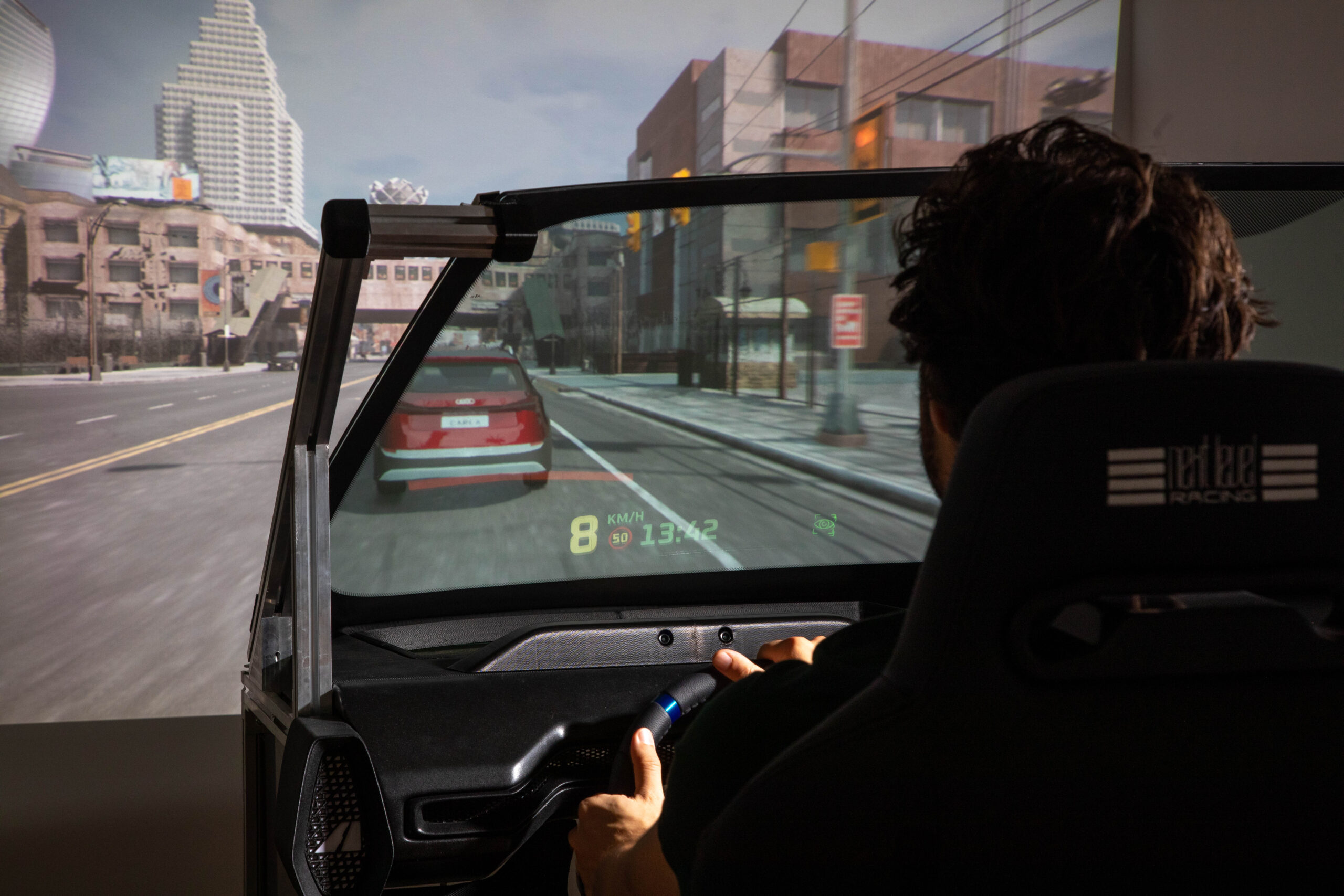
For a long time, the head-up display was considered one of the most intuitive success stories of automotive innovation. The idea was elegant and compelling: deliver critical information to the driver without requiring them to take their eyes off the road. Speed, navigation cues, warnings — all placed directly within the driver’s line of sight. It is no surprise that HUDs gradually moved from premium vehicles into ever wider segments of the market.
And yet, despite this apparent maturity, an increasingly uncomfortable question is emerging within the industry: are head-up displays truly evolving, or are we simply becoming better at managing their limitations?
Most HUD systems on the road today are built on essentially the same optical principles that were introduced more than a decade ago. Projected images, specialized windshields, and layers of optical compensation still form the backbone of the technology. This approach works — but only within strict boundaries. For years, those boundaries were acceptable because the amount and complexity of information displayed were limited. That context is now rapidly changing.
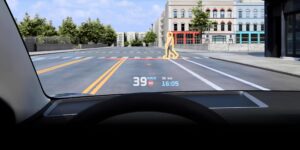
Typical HUD systems offer a horizontal field of view below 10–12 degrees. On paper, this may sound sufficient. In practice, it quickly becomes clear how restrictive this space really is. A speed readout or a simple navigation arrow fits comfortably, but as soon as manufacturers begin to talk seriously about augmented reality, spatial guidance, or environment-based visual cues, the system reaches its physical limits.
At that point, the HUD no longer extends reality — it compresses it. Instead of becoming a natural layer of spatial information, it turns into a digital “window” where too much data is forced into too little space. The problem is not the ambition of AR features, but the fact that current HUD architectures were never designed to scale in this way.
This limitation is not merely a question of ergonomics. It is structural. A projection-based HUD cannot simply grow larger or brighter without amplifying the optical side effects that have always been present — just tolerated at smaller scales.
One of the most visible of these side effects is ghost imaging. The driver does not see a single, stable image, but a faint secondary contour that shifts, doubles, or becomes more pronounced under certain lighting conditions. This is more than a cosmetic issue. Ghost images reduce perceptual clarity, increase cognitive load, and can negatively affect reaction time in critical driving situations. Importantly, this is not a software bug or a UX flaw. It is a consequence of physics — refraction, reflection, and the layered structure of the windshield itself.
Glare presents a similarly persistent challenge. Under strong sunlight, HUD images often lose contrast, fade into the background, or disappear entirely. The industry’s default response has been to increase brightness. But beyond a certain point, higher luminance does not solve the problem — it creates new ones. Excessive brightness amplifies unwanted reflections, increases visual noise, and further degrades image quality.
For a long time, these issues were accepted as manageable compromises. What has changed is the role the HUD is expected to play. The automotive industry is preparing to place orders of magnitude more visual information in front of the driver. Advanced driver assistance systems, sensor fusion, navigation, and environment perception increasingly rely on visual feedback. As a result, the HUD is no longer a secondary feature. It is becoming a core human–machine interface.
This is where the existing technological approach begins to fracture. Not because it is poorly executed, but because it was never designed for this level of responsibility. A system optimized for a narrow field of view cannot be transformed into a true augmented reality interface through incremental refinements alone.
“At a certain point, the question is no longer how much we can further optimize current HUD solutions, but whether it still makes sense to build on the same optical principles at all.” says Pál Koppa, CEO of aHead Photonics. “If we expect the HUD to become a natural extension of the driver’s visual perception, then the optical system itself has to be rethought from the ground up.”
The next generation of head-up displays therefore demands more than evolution — it requires a shift in perspective. Brighter images, higher resolution, or smarter software are not enough on their own. The more fundamental question is what we actually mean by a HUD. Is it merely an image projected onto a windshield, or is it an optical surface that actively participates in how information is formed and perceived?
In a fundamentally new approach, the windshield is no longer a passive medium. It becomes an intelligent optical interface. Such a system can deliver a genuinely wide field of view while eliminating ghost images and controlling unwanted reflections. Instead of forcing digital content into a narrow visual corridor, it allows information to merge naturally with the real environment.
This distinction is not only technical, but philosophical. It defines whether the driver must adapt to the limitations of the display, or the display adapts to the driver’s perception. In future vehicles, where visual complexity and automation continue to increase, there will be far less tolerance for compromise.
Head-up displays are not an outdated technology. On the contrary, they are becoming more critical than ever. But the mindset that views progress solely as incremental improvement of existing systems is increasingly a constraint. The next major leap will not come from polishing what we already know, but from deliberately redesigning the HUD concept itself.
The real question is no longer whether next-generation head-up displays are needed. It is who will be willing to say first that what we have relied on until now is no longer sufficient for what lies ahead.