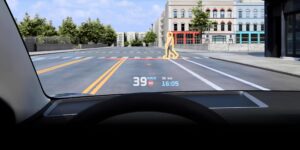
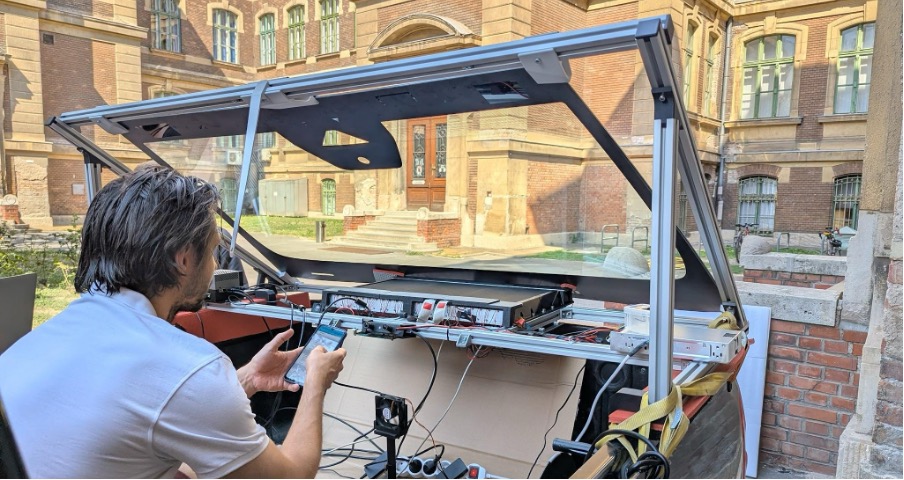
Developing a next-generation automotive Head-Up Display is not only about achieving outstanding results in the lab. A HUD must perform where it truly matters: in real-world conditions, under changing light, heat and vehicle movement.
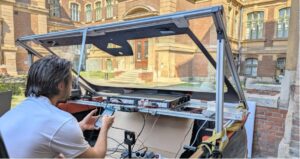
At aHead Photonics, we recently put our HUD demonstrator through an extensive outdoor test to evaluate its image quality, mechanical stability, thermal resistance and eye-tracking performance.
From Bright Sunlight to Darkness
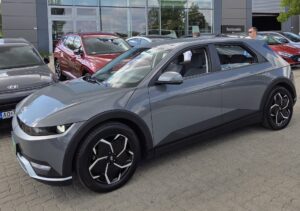
The HUD demonstrator was mounted on a vehicle and tested for approximately seven hours, covering six significantly different natural lighting scenarios – from strong daylight and direct sunlight to twilight and darkness.
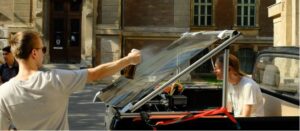
We also introduced real-world factors such as dust and water on the windshield, polarized sunglasses and different artificial light sources.
The participants evaluated the HUD based on four key parameters: ghost image, brightness, resolution and image homogeneity.
Strong Visual Performance
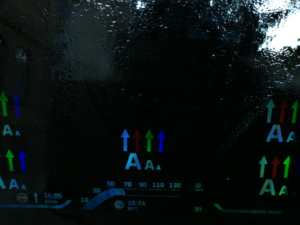
The results showed strong image quality across a wide range of conditions.
During daytime testing in shade, ghost image performance received a perfect 5.00/5, while brightness scored 4.00/5 and resolution 4.18/5. Under strong overhead sunlight, ghost image performance again achieved 5.00/5, with resolution reaching 4.33/5.
At twilight and in darkness, brightness received 5.00/5, demonstrating strong visibility as ambient light decreased.
One particularly encouraging result was performance with polarized sunglasses. In several daylight scenarios, participants actually rated perceived brightness higher while wearing them. In shade, for example, the average brightness score increased from 4.00 to 4.64.
Built to Handle Heat and Movement
The test was conducted in demanding summer conditions, with ambient temperatures between 35°C and 42°C. Parts of the vehicle platform exceeded 60°C, while some system components reached temperatures above 80°C during operation.
Despite these conditions, the HUD operated flawlessly throughout the test. The extreme heat revealed some material-related development points, particularly deformation of the PLA directional filter, providing valuable input for the next prototype iteration.
The system also successfully handled vehicle movement, with acceleration peaks of approximately 2.6–2.8 m/s², without mechanical damage or interruption of operation.
One Step Closer to the Road
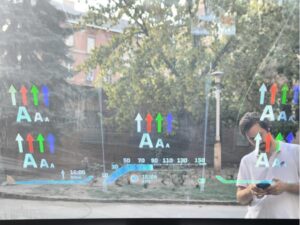
Eye tracking performed reliably across all tested participants, lighting conditions and even when sunglasses were worn, extending the usable eyebox and significantly improving the overall visual experience.
Overall, the outdoor test confirmed that our HUD demonstrator can maintain stable operation and strong visual performance across challenging real-world conditions – while also identifying clear opportunities for further optimization.
For aHead Photonics, this is exactly the purpose of testing beyond the lab: turning innovative optical technology into a robust automotive solution ready for the real world.