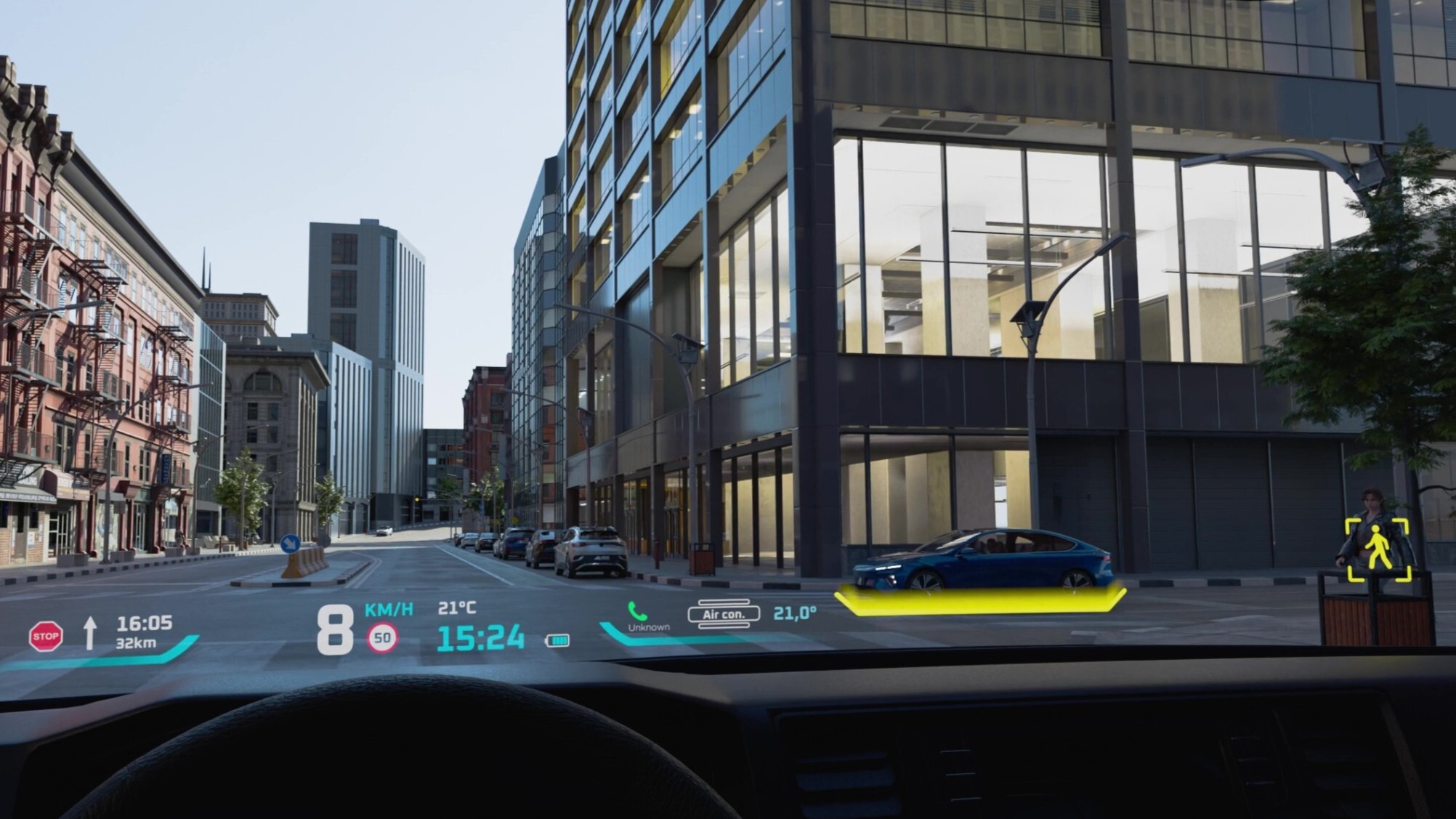
Throughout automotive history, real breakthroughs have rarely come from making existing technologies slightly faster, brighter, or sharper. The most meaningful leaps happened when the relationship between humans and vehicles fundamentally changed. The seatbelt, ABS, and electronic stability control were not incremental upgrades — they redefined how safety and control were understood. Today, there are growing signs that augmented reality on the windshield may represent the next such paradigm shift.
Modern driving is made easier thanks to the high level of automation and advanced driver assistance functions. On the other hand, today’s drivers are distracted by a huge amount of h fragmented information, so driver distraction became one of the leading causes of accidents. Instrument clusters, central displays, warning signals, mirrors, mobile phones, radio settings, navigation and the real-world environment all compete for our attention. This constant switching of focus increases cognitive load, which directly affects reaction time and decision quality.
This is where AR-based head-up displays represent a qualitative change. Their value is not in adding yet another layer of data, but in connecting digital information with physical space, turning raw data into immediately understandable context.
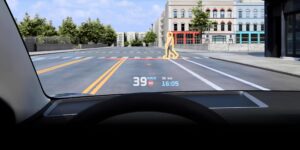
A well-designed AR HUD does not simply float icons on the windshield or decorate the driving experience with graphics. Instead, it interprets the environment for the driver. Lane boundaries appear exactly where the vehicle should travel. Navigation guidance aligns with the actual road geometry rather than pointing abstract arrows. Potentially hazardous situations — a pedestrian approaching the roadway, a cyclist in motion, a complex intersection — are highlighted within their real spatial context.
This distinction may seem subtle, but its impact is profound. The driver is not asked to process information, but to perceive meaning. The human brain reacts far faster to interpreted situations than to isolated data points.
The question of reaction time makes this difference tangible. Numerous studies [ref?] and real-world observations show that traditional displays can introduce delays of half a second or more. This is not because screens are slow, but because drivers must repeatedly shift their gaze away from the road and back again. Each glance interrupts the natural chain of perception, decision, and action.
With an AR HUD, the driver’s gaze remains on the road. There is no downward glance, no mental translation. Information appears exactly where decisions are made. At highway speeds, this can translate into a reaction advantage of 10–15 meters. In critical situations, that margin is not a convenience — it is a safety reserve.
Augmented reality also enables something that conventional displays cannot: making the invisible visible. Modern vehicles continuously monitor their surroundings through cameras, radar, and other sensors. These systems detect motion, anticipate trajectories, and identify risks long before a human driver consciously registers them. Yet sensor data alone has limited value if it is not intuitively communicated.
Here, the AR HUD acts as a translator. It converts sensor input into spatial visual cues. It can indicate the projected movement of a pedestrian, highlight an active blind spot directly in the driver’s field of view, or visualize the optimal path for a lane change. Crucially, this happens without distracting the driver — it focuses attention instead of fragmenting it.
“The true value of AR is not that it shows more information, but that it requires less thinking,” says Pál Koppa PhD, Founder and Managing Director of aHead Photonics. “When the system works properly, the driver doesn’t feel like they are using technology at all. Decisions simply become more intuitive.”
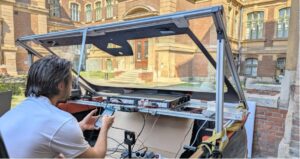
This philosophy is central to the work of aHead Photonics. The company is developing optical and display technologies that enable augmented reality to move beyond narrow, compromise-driven HUD implementations and become a truly spatial information system integrated into the windshield itself. The goal is not to increase information density, but to ensure that digital content blends naturally with the real environment, reducing cognitive load while improving reaction safety.
aHead Photonics’ approach starts from a clear premise: the physical and optical limitations of conventional projection-based HUD systems cannot be overcome by software alone. True AR requires new optical foundations, where the display, optical architecture, and windshield function as a single, unified system. Only this makes it possible to achieve a wide field of view, eliminate ghost images and glare, and ensure that augmented content feels like part of the driver’s perception rather than an overlay competing for attention.
The impact of augmented reality does not stop at safety. It also transforms the driving experience itself. Navigation no longer interrupts the journey but flows with it. Visual cues are no longer dominant elements demanding attention, but subtle guides that adapt to the situation. Information can be personalized, adjusting to driving style, traffic conditions, and even momentary workload.
This raises an important question: why is this becoming feasible now? Why was augmented reality on the windshield not a realistic proposition ten years ago?
The answer lies in the simultaneous maturation of the technological ecosystem. Optical solutions capable of delivering wide fields of view without distortion have emerged. Real-time AR processing can now handle sensor fusion with minimal latency. Automotive environment sensors are readily available as cameras, radars, lidars, infra-red detectors, ultrasounds etc.Vehicle architectures provide the computational power and data bandwidth required to integrate these systems reliably. What was once experimental is now converging into a viable platform.
Still, it is important to recognize that AR HUDs are not merely an additional feature layered on top of existing systems. Genuine functionality demands a rethinking of optical design. Narrow field-of-view, projection-based HUDs are fundamentally limited in their ability to support true spatial augmentation. For AR to move beyond visual tricks and become a meaningful driver aid, the technology must adapt to human perception rather than forcing the driver to adapt to technical constraints.
In this sense, the windshield is no longer just a transparent surface. It becomes an intelligent interface — one that not only displays information, but helps the driver make sense of reality.
Augmented reality on the windshield is therefore not a visual extra. It is a logical next step in the evolution of mobility. It reduces cognitive strain, enhances safety, and creates a more natural relationship between humans and increasingly complex vehicles. It is not a distant vision, but an actively developing technological direction — one that companies like aHead Photonics are already shaping today by redefining what a head-up display can and should be.
The question is no longer whether augmented reality will appear in future vehicles. The real question is in what quality, and who will be able to align this new visual language with the way humans actually see, think, and decide.