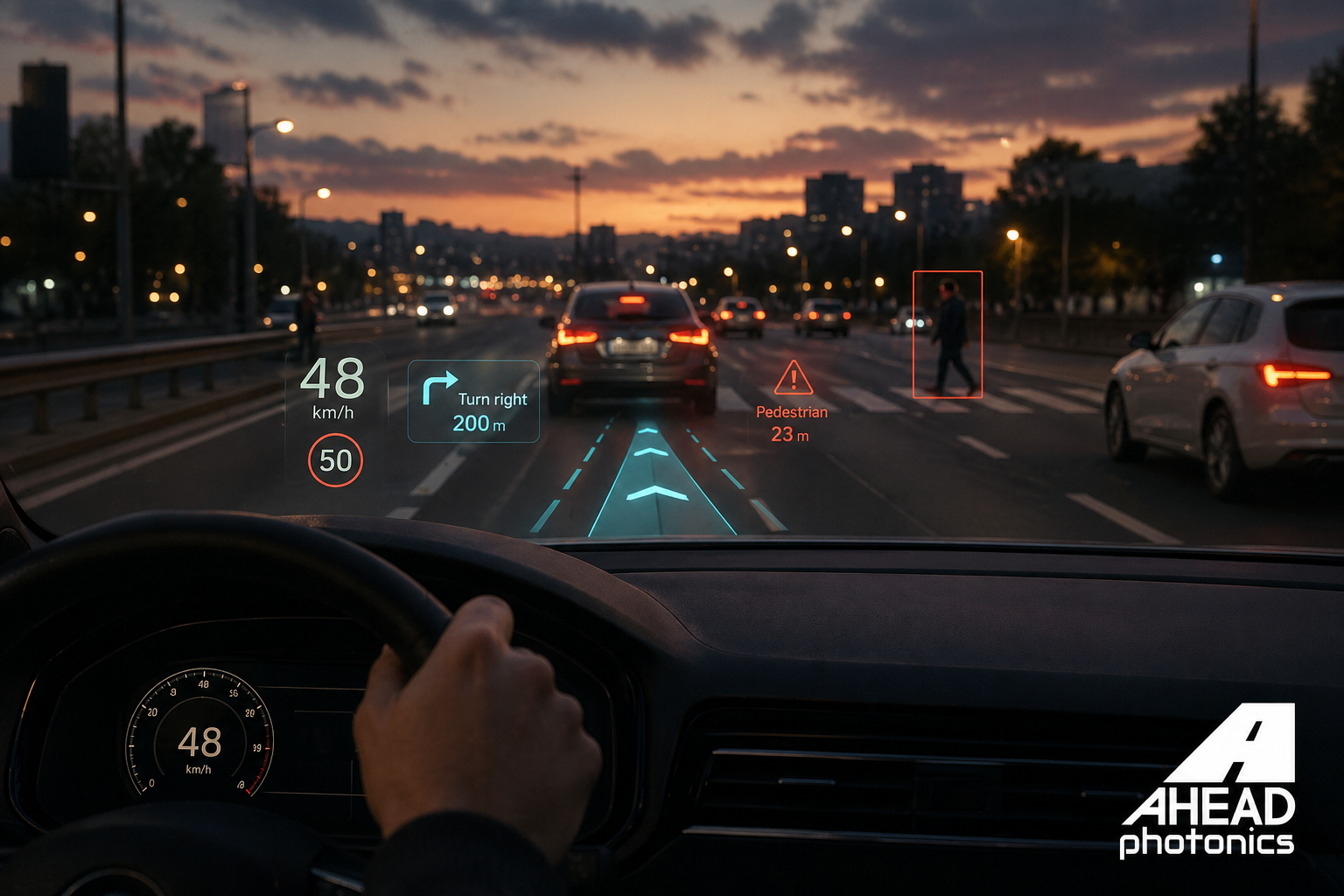
There’s a moment every driver knows. A quick glance down at the dashboard—just a second. But by the time your eyes return to the road, something has already changed. The car ahead is closer, a pedestrian has appeared, or traffic has subtly shifted.
This is where many mistakes begin.
Modern vehicles provide more information than ever before. Navigation, speed, warnings, driver assistance systems—all designed to help. Yet the more information we add, the greater the challenge becomes: how to deliver it without taking attention away from the road. Traditional displays, no matter how advanced, still require drivers to briefly disengage from driving.
And in traffic, sometimes that brief moment is all it takes.
Head-Up Display (HUD) technology addresses this problem in a fundamentally different way. It doesn’t just add more data—it changes how data is delivered. By projecting key information directly onto the windshield, HUD allows drivers to keep their eyes on the road at all times. What seems like a small shift actually has a profound impact on both driving experience and safety.
It’s no coincidence that HUD is rapidly moving beyond being a premium feature and becoming a core safety component.
Yet if we take a closer look at current systems, it becomes clear that the technology has not yet reached its full potential. Most existing HUDs display information within a relatively small area—a floating panel within the driver’s field of view. This works well for speed or simple navigation cues, but it falls short when it comes to delivering complex, real-time visual support.
Today’s systems typically operate within a limited field of view, restricting how much and how effectively information can be presented.
But this is not where the future is heading.
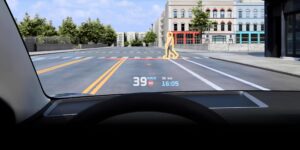
The real breakthrough comes with Augmented Reality (AR) HUD systems, where information is no longer separate from the environment—it becomes part of it. Navigation is no longer a symbol in the corner, but a direction embedded directly onto the road. Hazards are not icons, but highlighted elements within the driver’s actual field of vision.
At this point, technology doesn’t just inform—it helps interpret reality.
For this vision to work, however, one critical condition must be met: the field of view needs to expand dramatically. The next generation of HUD systems aims for ultra-wide fields of view—up to 40° × 15°—transforming the windshield into an integrated visual interface.
This is no longer a display—it’s a layer of perception.
The challenge is technological. Conventional projection-based HUD systems simply cannot scale to this size without introducing optical distortions, glare, or integration issues.
This is where new approaches emerge.
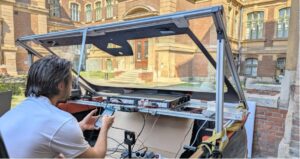
aHead Photonics is developing a fundamentally different solution based on a flat-panel HUD architecture. This approach enables an ultra-wide field of view—limited only by the physical dimensions of the windshield—while eliminating disturbing optical effects such as ghosting and glare.
“From a road safety perspective, the key question is not how much information we show, but where and how we present it. When information becomes a natural part of the driver’s field of view, it no longer distracts—it supports. And that has a direct, measurable impact on reaction time.”– Pál Koppá, CEO of aHead Photonics
This is more than a technological upgrade—it’s a shift in mindset.
Ultimately, it’s not about the display itself, but about how quickly and accurately a driver can understand a situation. If there is no need to look away from the road, if information appears exactly where it is needed, and if it can be interpreted instantly, then reaction times improve, decisions become faster, and driving becomes safer.
The evolution of HUD technology may be less visible than the promise of autonomous driving, but it points in the same direction: a future where technology does not replace the driver, but enhances human decision-making at the critical moment.
And in the end, it may be those saved seconds that make all the difference.