Automotive display development has accelerated significantly in recent years. Digital instrument clusters, central touchscreens and wide panoramic displays are no longer futuristic features, but natural parts of the modern vehicle interior. What once appeared only in premium models is increasingly becoming a standard expectation across the market.
The next major leap, however, may not simply be about placing an even larger screen on the dashboard. It is increasingly about where, when and how information appears.
Not every display is equally useful while driving. Data can be accurate, a warning can be relevant, and navigation instructions can arrive at the right moment — yet they may still lose value if the driver has to look away from the road or mentally connect the information on a screen with the real traffic situation. As vehicles generate and process more data, it becomes more important that this information supports understanding rather than adding cognitive load.
Head-Up Display technology addresses exactly this challenge. HUD systems place key driving information in the driver’s field of view, making it visible through the windshield instead of on the dashboard or central display. This already reduces the need for drivers to repeatedly shift their attention away from the road.
However, today’s HUD systems still typically operate within a limited display area. They are well suited for showing speed, simple navigation cues or basic warnings, but their field of view limits how effectively they can interact with the outside environment. A smaller HUD acts more like an information window. The next generation of AR-HUD, by contrast, becomes part of the driving environment itself.
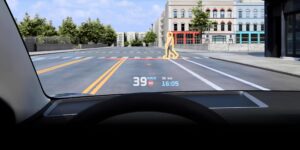
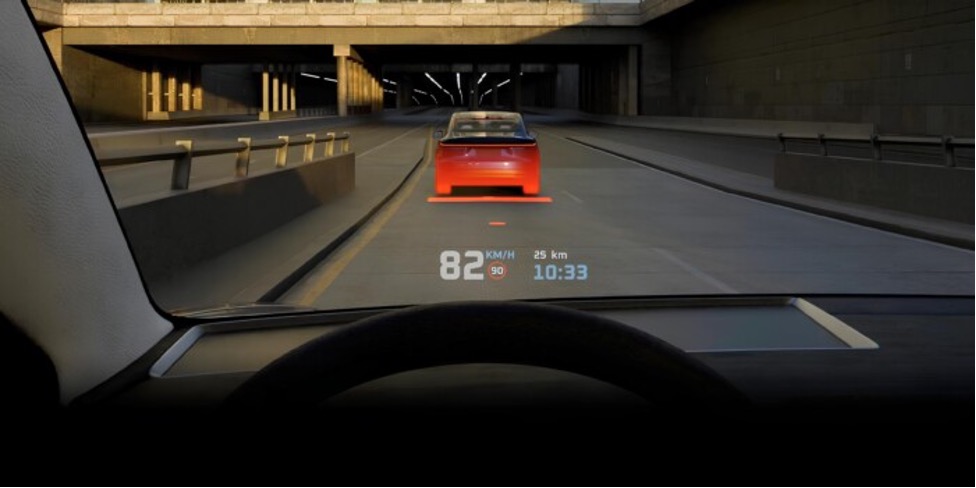
The real significance of Augmented Reality HUD lies in the way digital content is aligned with the real traffic situation. A navigation cue is no longer just an icon somewhere in the driver’s view, but a visual guide placed directly onto the road. A hazard warning is not merely an abstract alert, but a highlight of the risky object or situation exactly where the driver needs to notice it. Information from driver assistance systems becomes part of the decision-making process rather than a separate layer of data to interpret.
For this to work naturally, current HUD dimensions are not enough. AR content requires sufficient visual space to become truly integrated into the driving experience. This is why Wide Field of View is becoming one of the key directions in automotive display development. Ultra-wide AR-HUD does not simply mean a larger image; it means a different quality of information delivery. The system does not just show information — it provides context.
At this point, the challenge is no longer only about design or user experience. It becomes a technological question. How can a larger field of view be created while keeping the image stable, clear and distortion-free? How can ghosting, glare and other optical disturbances be eliminated, especially when they become more visible on larger display surfaces? How can such a system be integrated into the vehicle without requiring excessive space, while still fitting the architecture of future vehicle interiors?
Traditional projection-based HUD systems may not be the best answer to these questions. What works in a smaller field of view cannot necessarily be scaled with the same logic to ultra-wide AR display. As the role of HUD expands, solutions that start from a new architecture — rather than stretching the compromises of existing optical systems — become increasingly important.
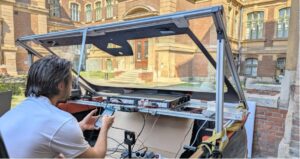
The development work of aHead Photonics points in this direction. The company is working on a flat panel-based HUD technology that approaches wide field-of-view display differently from conventional projection systems. One of the key promises of the concept is that the field of view should not be limited by traditional optical architectures, but should instead move closer to the physical possibilities of the windshield. This could open the way toward more compact integration, better image quality and the elimination of disturbing optical effects.
“Wide field-of-view AR-HUD does not simply mean a larger display. The real breakthrough comes when information no longer appears as a separate element in front of the driver, but naturally aligns with what the driver sees on the road. This requires technological foundations that are not built around the limits of today’s HUD systems, but around the logic of next-generation display.”
— Ábel Sulyok, aHead Photonics
The difference becomes especially important in real driving situations. A lane-change warning, pedestrian detection, a turning instruction or a suddenly emerging hazard can be understood much faster when the visual cue appears exactly where the driver’s attention is already focused. The goal is not to show the driver more information, but to help them understand what matters with less effort.
The direction of the industry is clear: vehicles are processing more information from sensors, cameras, radar and driver assistance systems. Yet this data creates real value only when it is presented to the driver in a form that is immediately understandable and usable. Display development is therefore becoming less about screens in isolation, and more about how the vehicle’s visual system can become an active tool for decision support.
In this process, Wide FoV AR-HUD is not a spectacular extra, but a logical next step. As vehicles become better at sensing and interpreting their surroundings, the need also grows for that interpretation to reach the driver in a natural way. Not on a separate display, not as an afterthought, and not by dividing attention — but directly within the driver’s field of view.
This is where aHead Photonics’ innovation becomes especially relevant: at the intersection of display technology, optics, automotive integration and driver attention. The next generation of HUD is not only about what a vehicle can display, but also about how clearly, naturally and safely it can display it.
In the car of the future, the display will no longer be just a screen. It will be more than a surface showing data. It will become a visual decision-support layer built onto the real environment, helping drivers react faster, more accurately and with greater confidence.
The next major display leap may therefore not happen in the center of the cabin. It may happen where the driver’s attention already is: forward, on the road.