Most decisions we make while driving are not conscious. A brake light flashes, a pedestrian steps off the curb, a car suddenly changes lanes — we don’t analyse, we react. And in those reactions, fractions of a second can make all the difference.
At the same time, modern vehicles are delivering more information than ever before: navigation, speed, driver assistance alerts, warnings. The paradox is clear — while cars have become “smarter,” human attention has not increased. In fact, poorly placed or excessive information can actively reduce safety.
From this perspective, the real question is no longer how much data we provide, but how we deliver it to the driver.
The Cost of Looking Away
A typical glance at the dashboard or center console takes between 0.5 and 2 seconds. That may seem negligible — until you translate it into distance. At 90 km/h, that means traveling 12 to 50 meters without actually watching the road.
This isn’t an edge case. It’s everyday driving.
Unsurprisingly, research consistently shows that divided attention is one of the leading contributors to road incidents, increasing the likelihood of critical events by as much as 20–30%. Even a slight delay in reaction time can be enough to turn a near-miss into a collision.
What Does a HUD Change?
The principle behind Head-Up Displays is simple: instead of forcing the driver to adapt to the display, the display adapts to the driver.
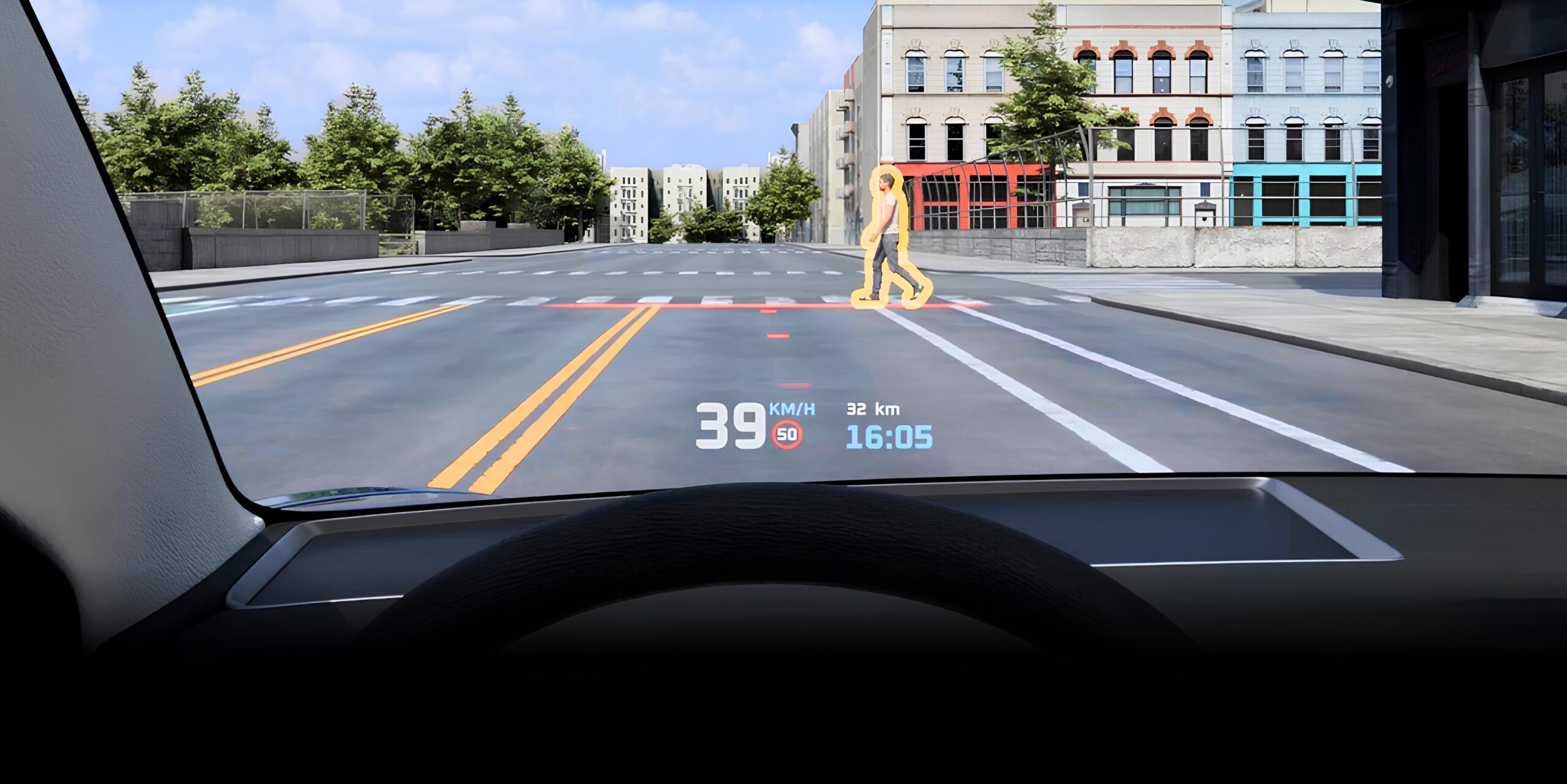
Key information — speed, navigation cues, warnings — appears directly in the driver’s line of sight, projected onto the windshield. There’s no need to look down, refocus, or mentally “return” to the road.
The impact of this is measurable.
Studies and industry analyses indicate that HUD usage can reduce reaction time by as much as 0.5–1 second in critical situations. In urban driving, that translates to several meters. On highways, it can mean an entire car length — often the difference between avoiding an accident and not.
At the same time, drivers spend less time looking away from the road, and their situational awareness improves. They detect hazards earlier and interpret traffic situations more accurately.
Faster Understanding, Not Just Faster Seeing
HUD systems don’t just reposition information — they also make it easier to process. This becomes even more powerful with augmented reality (AR) HUDs.
When a navigation arrow is projected directly onto the road you need to take, there’s no need for mental translation. When a potential hazard is visually highlighted within your field of view, recognition becomes immediate.
This kind of visual integration reduces cognitive load — meaning the brain works less to understand the situation. Over time, this doesn’t just make driving more comfortable, but significantly safer.
The Current Limitation: Field of View
Despite its advantages, today’s HUD technology still faces limitations. The most important one is field of view: most systems project information onto a relatively small area of the windshield.
This becomes a bottleneck, especially for AR applications, where accurate alignment with the real world is essential. If the visual content doesn’t fully match the driver’s natural field of view, it loses much of its intuitive value.
The direction of development across the industry is clear: wider field of view, more contextual information, better integration with the driving environment.
This is exactly where aHead Photonics is focusing its innovation. The goal is to deliver a HUD system with an ultra-wide field of view, free from optical artifacts such as ghosting and glare, enabling information to seamlessly integrate into the driver’s perception of reality.
“Road safety is not improved by showing more data, but by presenting the right information at the right place and the right time. That’s where new gen HUD technology creates real impact.”
– Pál Koppa, CEO, aHead Photonics
What Comes Next
Today, HUD is still often considered a premium feature. In the coming years, however, it is expected to become standard — not because of aesthetics, but because of safety.
As vehicles take on more responsibility in assisting or even partially automating driving, it becomes increasingly important that drivers clearly understand what is happening around them. In this transition, HUD — especially wide field-of-view, AR-based systems — will play a critical role.
Because ultimately, everything comes down to one simple question:
it’s not how much information we have — it’s whether we see it in time.